

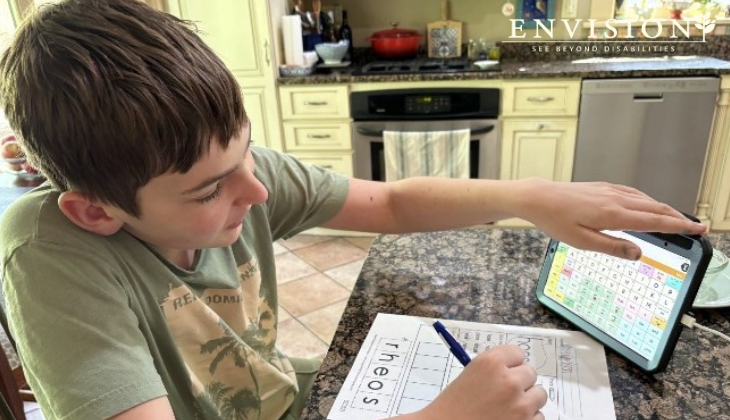
At 13 years old, Wyatt is discovering more than just words—he is discovering his voice, his confidence, and his ability to connect with the world around him. Wyatt’s communication journey has been years in the making, shaped by perseverance, family support, and the transformative work of CITE Services.
Wyatt was just four years old when CITE first began working with his family. Like many young children who struggle with communication, Wyatt found ways to make himself understood through physical actions. He would wrestle, push, grab, and use his body to express his needs and emotions. At that time, Wyatt could speak only a few three-word phrases, and daily communication was often frustrating—for both Wyatt and those who loved him.
During his early time with CITE, everything began to change. With patient guidance from CITE staff, Wyatt learned to respond to “Yes” and “No” using visual support. From there, he was taught to make simple verbal requests using three-word sentences such as, “I want ___.” These small but powerful steps allowed Wyatt to replace physical behaviors with meaningful communication. By the end of that service period, he was proudly naming items around his home—an exciting breakthrough for Wyatt and his family.
Years later, at age 12, CITE Services returned to Wyatt’s life at a critical moment. Although his spoken language had grown, much of his communication relied on echolalia, the repetition of words or phrases spoken by others. When expressive speech is challenging, many individuals find success through Augmentative and Alternative Communication (AAC)—and Wyatt was ready to take that next step.
Wyatt had already been introduced to a speech-generating tablet at school and in Speech Therapy. By touching pictures on the screen, the device would speak words and phrases aloud, giving Wyatt a reliable way to express himself. CITE staff worked closely with Wyatt and his family to bring this tool into daily life at home, helping everyone learn how to support and encourage communication outside of therapy sessions.
The progress that followed was remarkable.
Through consistent practice, teamwork, and a strong love of learning nurtured by his family, Wyatt began using his AAC device in increasingly meaningful ways. One of his first major breakthroughs was learning to identify and express his emotions. Being able to say how he was feeling had a powerful impact on both his behavior and his mood. When Wyatt gained the words for his emotions, he no longer needed to use his body to communicate frustration, excitement, or discomfort—his device helped him be heard.
Next, Wyatt learned to identify and talk about 14 different body parts. This skill goes far beyond naming—it supports bodily autonomy, self-advocacy, and personal safety. For a pre-teen, being able to communicate about one’s body is essential to dignity, independence, and health.
Wyatt’s communication skills continued to grow as he mastered the use of prepositions, allowing him to describe where objects are in relation to one another. This new language skill added richness and complexity to his conversations, helping Wyatt share ideas more clearly and confidently.
As his service period came to a close, Wyatt took yet another impressive step forward: using his AAC device to practice sight words he was learning in English class at school. By connecting his communication tools with his academic learning, Wyatt reinforced both his literacy skills and his confidence as a student.
Wyatt’s story is a powerful reminder of what is possible when families are supported, strengths are recognized, and communication is honored in all its forms. We are incredibly proud of Wyatt and his family for their determination, commitment, and belief in his abilities. Their journey shows that with the right tools and support, everyone is capable—and everyone deserves—a voice.
💜At CITE Services, stories like Wyatt’s inspire us every day.
Visit www.envisionohio.org to learn more about CITE Services, explore our programs, and discover how you can support individuals like Wyatt in building confidence, communication, and independence.